Many people today find themselves caught between two options. On one hand, is the hospital spirometry which is trusted and widely recommended. On the other, spirometer apps that promise convenience and regular tracking at home.
This creates a practical question. If both are measuring lung function, how much can you actually rely on a spirometer app?
Understanding this difference is important, especially when monitoring needs to go beyond occasional testing. This article looks at how spirometer apps compare to hospital tests, where they align, and where they offer something more.
What Do Spirometer Apps Actually Measure?
You can find a number of spirometer apps in the market today. Each of these may look same on the surface but could differ when looked at carefully.
For instance, some apps available today rely only on the phone’s microphone to estimate lung function. In these cases, the user is asked to blow air toward the phone where the app is installed. The app then attempts to estimate airflow based on sound patterns created during exhalation.
Using such an app may seem convenient and good enough. However, it does not directly measure lung function. It only provides rough estimates, which are not considered reliable for clinical use.
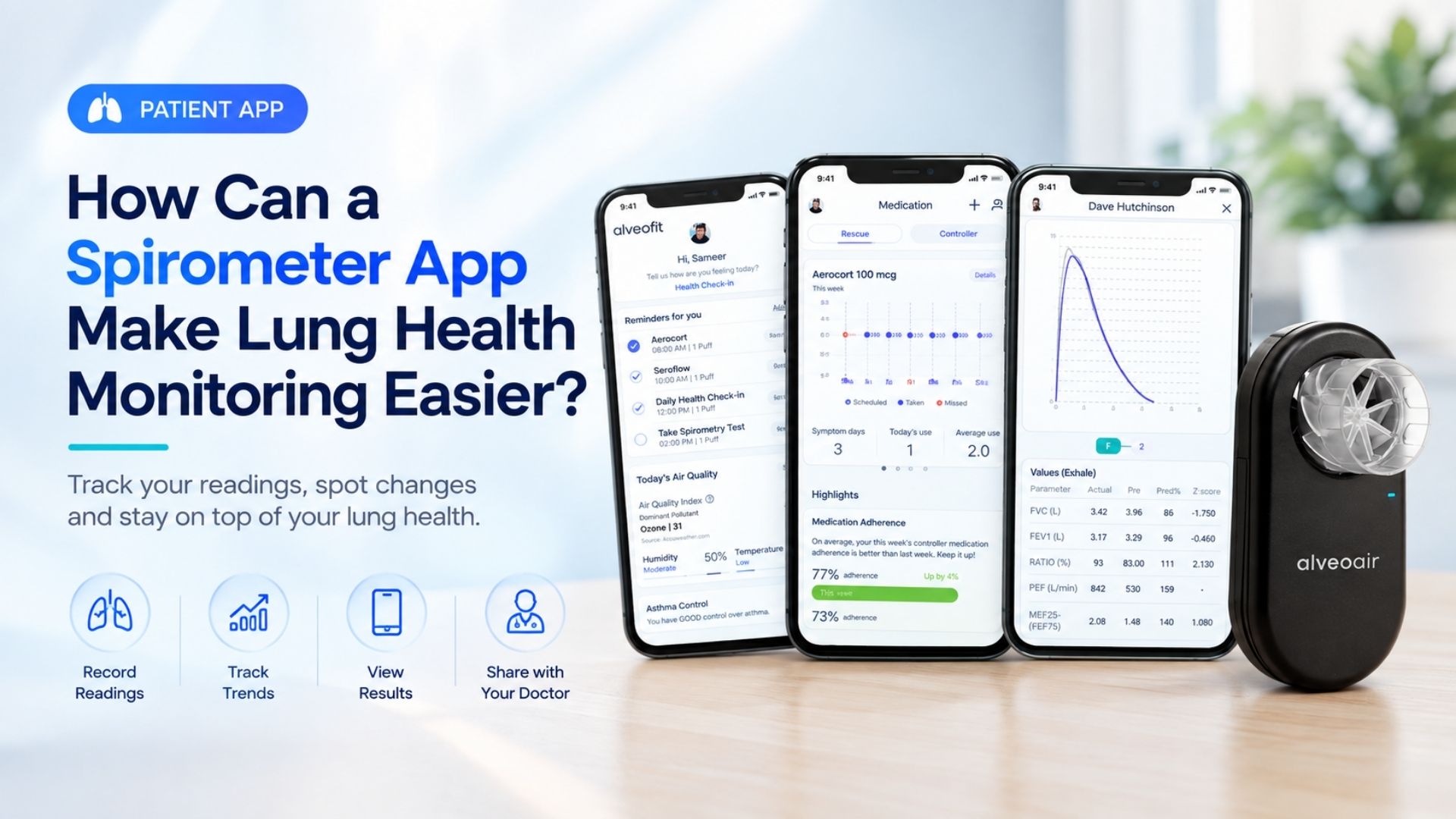
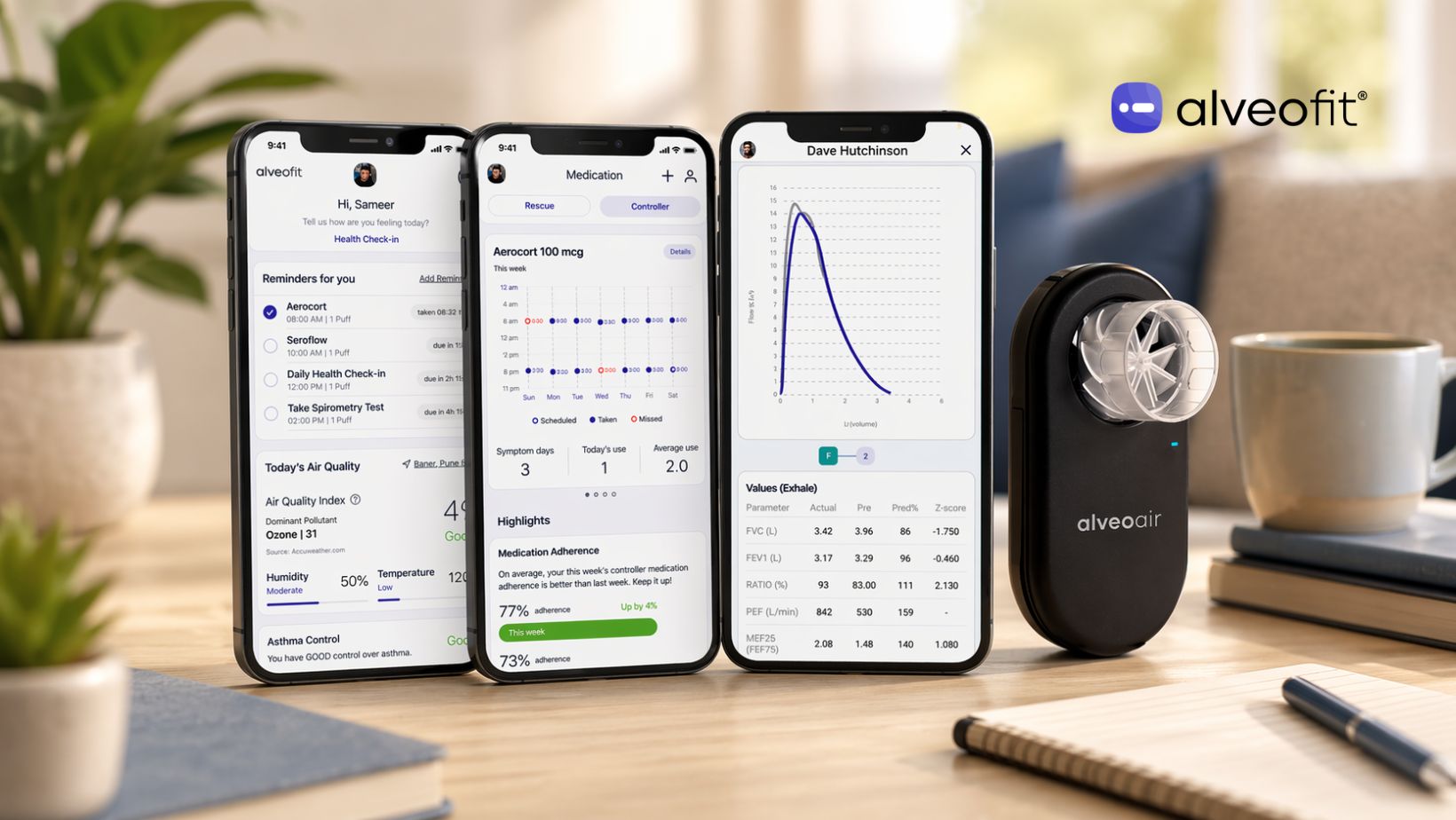
A more accurate approach involves a spirometer app that is connected to a dedicated device. The app works as an interface in this setup. Here, the actual measurement of airflow is performed by the spirometry device itself.
A spirometer app paired with a proper spirometry device typically measures:
- Airflow speed during exhalation
- Lung volume, including how much air you can exhale
- Key parameters such as FEV₁ and peak expiratory flow
- Changes in lung function over time through repeated readings
These systems are designed to capture real physiological data rather than estimates. The spirometry app then organises this data, making it easier to track patterns and interpret results.
This distinction between the two types of apps is very important. So, is accuracy a non-negotiable for you? If so, then you should always use spirometer apps that work with calibrated, medical-grade devices, not those that rely on indirect estimations.
How Accurate Are Hospital Spirometry Tests?
Hospital spirometry has been considered the clinical benchmark for years. This level of trust comes from how carefully the test is conducted.
Hospital spirometry is performed in a controlled environment. Here, the spirometry device is regularly calibrated against standard reference values to ensure accuracy. The test is also carried out under the supervision of trained professionals who guide the patient through each step.
These professionals ensure the patient inhales fully, seals the mouthpiece correctly, and exhales with the required force and timing. This guidance reduces errors and improves the reliability of the results. Because of this structured process, hospital spirometry offers:
- High measurement accuracy
- Standardised and comparable results
- Reliable data for diagnosis and clinical evaluation
This is exactly why it remains the most trusted method for diagnosing and assessing lung conditions.
However, this level of accuracy comes with practical limitations. Patients cannot visit hospitals frequently for repeated testing. This is especially true for those living in remote areas or managing chronic conditions that require regular monitoring. This creates a gap between clinical assessment and day-to-day lung function.
The test itself also captures lung function at a single point in time. It reflects how the lungs perform in that specific moment under controlled conditions. However, it does not always show how lungs behave throughout the day or across different environments.
This is where home-based monitoring begins to play an important role. But are home spirometry tests as reliable as hospital testing?
How Reliable Are Home Spirometry Tests?
Home spirometry tests are designed to make lung function assessment more accessible and consistent outside a clinical setting. You do not have to rely on “occasional” hospital visits when you have a home spirometry device. These tools allow users to monitor their breathing regularly in real-life conditions.
When performed correctly using a validated device, home spirometry tests offer:
- Measurement of key lung parameters, such as airflow and lung volume
- The ability to track lung function more frequently
- Better visibility into how breathing changes across days or weeks
- Early identification of a gradual decline before symptoms become noticeable
This level of access makes home spirometry particularly useful for individuals managing chronic respiratory conditions or those who need ongoing monitoring.
Home spirometry readings can closely align with hospital spirometry in terms of reliability. However, this is only possible when the device is accurate and the test is performed consistently.
The problem is, unlike hospital testing, the process is not supervised. This means the reliability depends on how well the user follows the correct technique and maintains consistency in testing conditions. This is where the role of digital support becomes important, especially when home spirometry is combined with structured tracking tools.
How Spirometer Apps Improve the Reliability of Home Spirometry?
Home spirometry tests already provide valuable insights. However, their reliability improves significantly when they are used alongside a spirometer app.
Remember that not all home spirometry devices are paired with apps. Some operate independently and display readings directly on the device. Such devices still provide useful data, but they often limit how effectively that data can be tracked and interpreted over time.
The same process, however, becomes more structured and consistent when a spirometer app is integrated with the device. A spirometer app helps improve reliability by:
- Automatically recording and storing each reading without manual effort
- Maintaining a consistent log of results, reducing the risk of missed or forgotten data
- Allowing users to compare current readings with past performance
- Highlighting gradual changes that may not be noticeable in single tests
- Supporting better adherence by making tracking easier and more accessible
This added structure reduces the chances of error and improves the overall quality of monitoring.
As a result, spirometer apps do not just make home spirometry more convenient. They make it more dependable. These apps turn individual readings into continuous data. This aspect of spirometry apps helps users and clinicians gain a clearer understanding of how lung function is changing over time.
Where Spirometer Apps Go Beyond Hospital Testing
The real value of a spirometer app is not limited to matching the accuracy of hospital tests. It lies in what it allows you to observe over time.
Your lung function does not decline suddenly. The change begins gradually, often days or even weeks before noticeable symptoms appear. During this phase, the airways may already be under stress, yet the patient may feel normal or assume everything is under control.
This is where relying only on occasional hospital tests creates a gap. A spirometer app helps bridge this gap by making lung function visible on a daily basis. It allows you to:
- Track lung function regularly instead of waiting for scheduled visits
- Monitor how your breathing behaves in real-life conditions
- Detect subtle declines before they develop into symptoms
- Understand patterns, triggers, and early warning signs
This continuous visibility changes how lung health is managed. Instead of reacting to symptoms, it allows earlier awareness and more timely action.
These early changes often go unnoticed without this kind of monitoring. In fact, the decline may already be more advanced than expected by the time symptoms appear or the next hospital test is done.
This is exactly where a spirometer app becomes crucial. It turns single readings into ongoing insight, helping you stay aware of changes that would otherwise remain hidden.
Conclusion
Hospital spirometry continues to remain a critical part of respiratory care. It provides the accuracy and structure needed for diagnosis. It is also crucial for baseline assessment and detailed clinical evaluation, especially in complex conditions where precision is essential.
At the same time, spirometer apps are not designed to replace this process. Their role is different. They extend monitoring beyond the hospital and bring continuity to how lung function is tracked over time.
This is the idea behind solutions like alveofit. Our spirometer app combines reliable spirometry with structured app-based tracking. It helps bridge the gap between clinical assessment and everyday monitoring.
Lung health is no longer limited to occasional tests with this approach. It becomes something you can observe, understand, and manage more consistently using alveofit’s spirometer and app.