Why Choose a US FDA 510(k)-Cleared Spirometer in India?
Spirometry decides how COPD and asthma are diagnosed and treated, so the device matters. Here is what US FDA 510(k) clearance means, what it does not mean, and what to look for in a spirometer in India.
Spirometry is the test doctors rely on to diagnose and follow chronic obstructive pulmonary disease (COPD) and asthma. A reading that is off by a few per cent can change a diagnosis or a treatment plan, so the device you choose matters as much as the test itself.
One question we hear often from doctors in India is whether a spirometer is "FDA approved". For most spirometers the accurate term is US FDA 510(k) cleared, and the difference is worth understanding.
What US FDA 510(k) clearance means
In the United States, most spirometers reach the market through a 510(k) premarket notification. The manufacturer shows the US Food and Drug Administration (FDA) that the new device is as safe and effective as a device already legally on the market, with test data to support it. When the FDA agrees, it clears the device for sale in the US.
Clearance is different from approval. Approval (premarket approval, or PMA) is a separate route used for higher-risk devices. A 510(k)-cleared device should be described as cleared, not approved.
Manufacturers selling in the US must also run a quality management system that covers design, production and complaint handling, and report problems after the device is on the market.
How spirometers are regulated in India
In India, medical devices are regulated by the Central Drugs Standard Control Organisation (CDSCO) under the Medical Devices Rules, 2017. A US FDA clearance does not replace Indian registration; a spirometer sold in India needs to meet Indian requirements as well.
COPD and the role of spirometers
COPD is a chronic inflammatory lung disease that obstructs airflow and makes breathing difficult. Spirometers measure how much air a person can breathe out, and how fast. Accurate readings are vital for diagnosing COPD, judging its severity, adjusting treatment and tracking change over time.
What to look for in a spirometer
Whatever its regulatory status, a good spirometer for clinical use should offer:
- Accuracy you can check. Calibration checks, and results that meet the ATS/ERS 2019 spirometry standard for test quality and repeatability.
- Quality grading during the test. Feedback on each blow, so the operator knows when a test is acceptable and when to coach the patient to try again.
- Reference values that fit the patient. Predicted values and z-scores from GLI-2012 reference equations, so a result is judged against people of the same age, height and sex.
- Software that keeps the record. Results stored on the patient's file, easy to share with the referring doctor and to compare across visits.
- Ease of use. A device elderly patients and patients with severe COPD can use correctly, and a workflow nurses and technicians can learn quickly.
- Safety and hygiene. Single-patient filters or mouthpieces and clear cleaning instructions.
Why regulatory clearance helps
A US FDA 510(k) clearance tells you the manufacturer submitted test data on safety and performance and that the FDA reviewed it. It is a useful signal when you compare devices, alongside Indian registration, the standards the device meets, and the support available after you buy it.
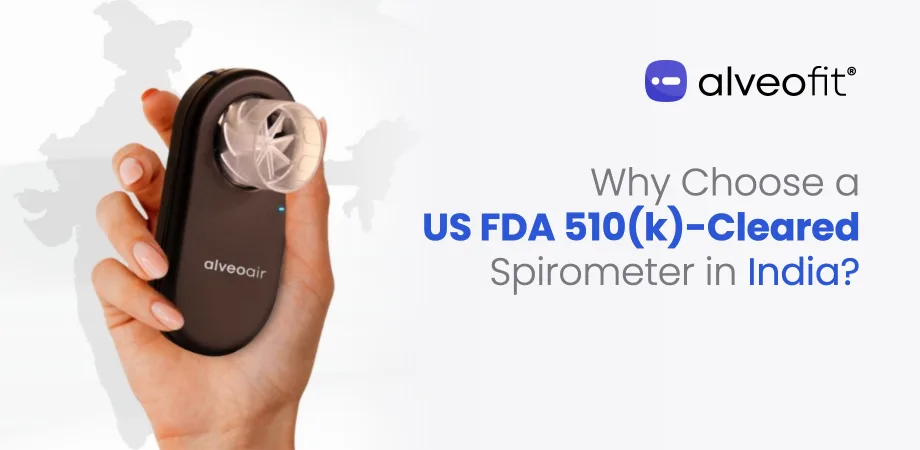
alveoair: US FDA 510(k) cleared
alveoair, the handheld digital spirometer from alveofit, is US FDA 510(k) cleared (K222525, August 2023) and is patented in India (No. 409921). It is designed, engineered and made in India, pairs with the alveoMD app for testing and patient records in the clinic, and grades every test against the ATS/ERS 2019 standard with GLI-2012 reference values.
Interpretation of every result remains the responsibility of the treating clinician.
See alveoair or book a demo to try it in your clinic.